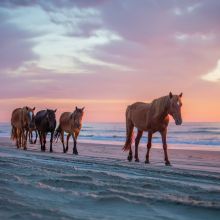
According to the Chinese Zodiac, 2026 is the year of the fire horse, an animal that represents independence, vitality, loyalty, power and stamina. Who better personifies those characteristics than the wild Banker horses of Corolla?
In past centuries, these horses survived the brutal environment of the Outer Banks when people could not. The original stock was brought to the New World by Spanish conquistador Lucas VazQuez de Ayllon, an explorer who tried to start a colony in North America in 1526 and had to abandon the horses on this coast. Then there was the 1585 expedition of English explorer Richard Grenville, in which it is suspected that Spanish mustangs and stallions swam to the shore from Grenville’s damaged ship that was too large to get to Roanoke Island.
The Banker horses have found the power, vitality and stamina to stand the test of time and roam these beaches freely for more than 500 years. But in modern times they began to suffer. In the 1980s, 20 horses were hit by vehicles following the paving of N.C. Highway 12 between the Currituck County line and Corolla. It became clear to a group of local citizens that the horses would need a little human assistance if they were going to meet the match of the threats of modern transportation, development and tourism. That group of citizens created the Corolla Wild Horse Fund, and it began a beautifully unique symbiotic relationship between human and animal.
“This started out very grassroots,” says Meg Puckett, director of herd management for Corolla Wild Horse Fund (CWHF). “Our organization was a group of citizens who came together and said, ‘We’ve got to be the change. We don’t like where this is going.’ That’s still one of the most important parts of how we exist – community involvement and people who come together because they believe in a cause.”
Incorporated as a 501 (c)3 nonprofit charity in 2001, CWHF has grown to focus on herd management, conservation efforts, education and outreach, rescue and rehabilitation, advocacy and research.
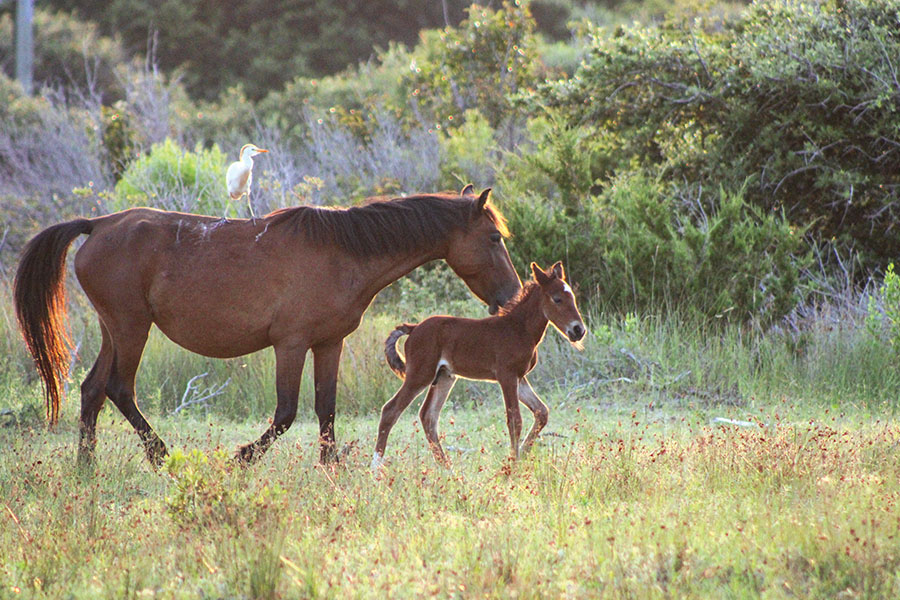
To learn the distinct characteristics of the horse breed, in recent years CWHF has amped up its DNA Research Project, in which they take DNA samples of the horses to provide answers about their identity and heritage. Puckett explains that by analyzing the DNA and ancestry of the wild horses, CWHF is able to gain insights into the horses’ personalities, behaviors and attitudes, as these traits can be passed down genetically.
“We are building an ancestry for this entire herd,” Puckett says. “We are able to make more purposeful decisions about breed conservation and population management using DNA and genetics. And then we also just learn a lot about the horses’ natural behavior, their movements, how they interact with each other and that kind of thing.”
In February 2026, CWHF staff gathered at their farm, the Betsy Dowdy Equine Center in Grandy, to usher in the year of the fire horse. A staff member shared the lessons we can all learn from the horses, one being that these animals are herd animals and that in a society that values individualism, they show us how to live in community, teaching, playing and comforting each other.
The staff also discussed the horses’ incredibly large electromagnetic field, which influences the energy of those around them. That is why people are often so moved emotionally just by being in the presence of a horse. But in the wild, for many important reasons, people must stay at least 50 feet away from the wild horses and admire them from afar. People also must never feed the horses.
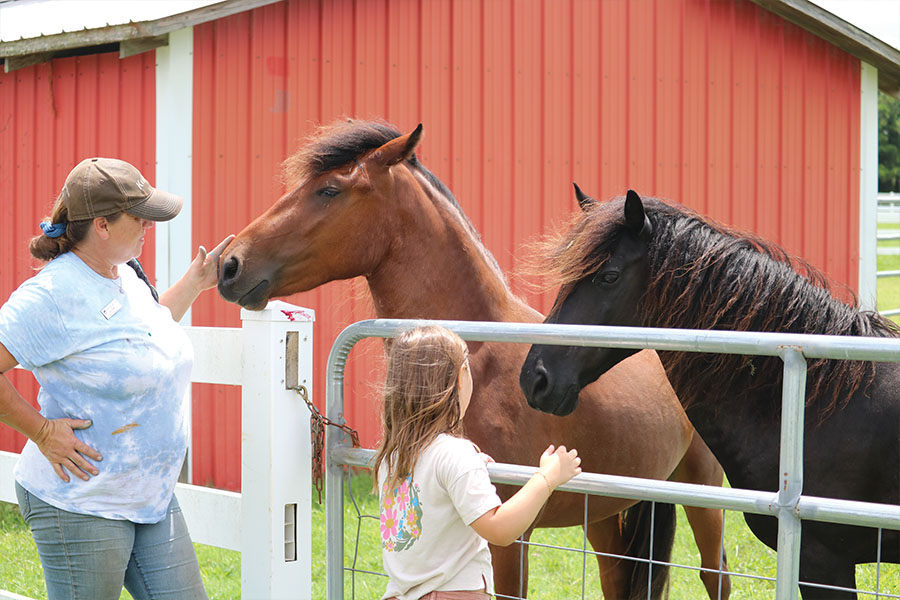
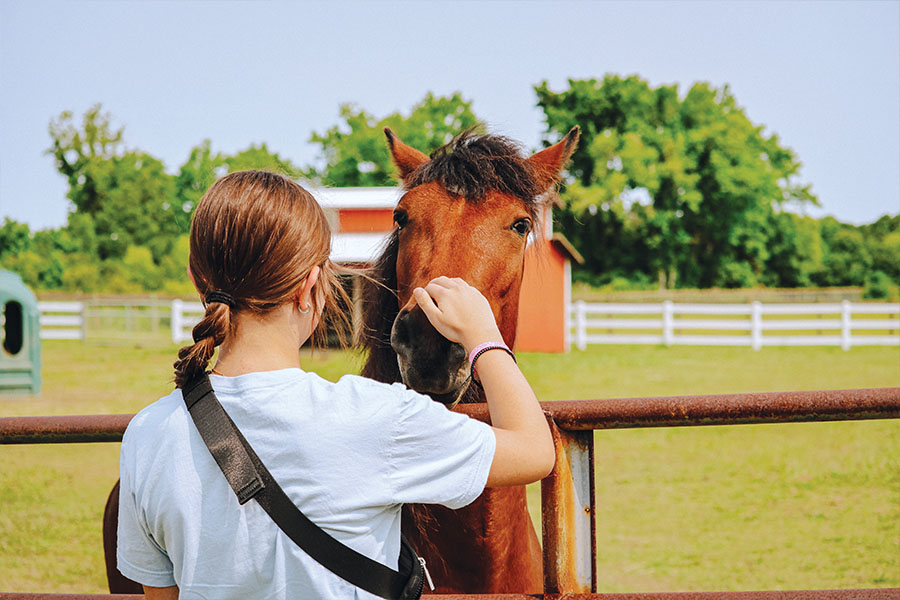
If you would like to experience the energetic field of a Banker horse up close, CWHF offers a wonderful opportunity at Mustang Mornings on summer Wednesdays. Here, the public has the chance to meet some of the Banker horses that have been rescued from the wild for various reasons.
“The horses on this farm tell the whole story of what we do,” says Puckett, explaining that while it’s important to experience them in the wild, this gives the public another way to interact with the animals up close. “I think everybody wants to touch them, right? Everybody wants to get up close, and you just can’t do that in the wild. Here, you can have that experience.”
At the Corolla Wild Horse Fund Museum in Historic Corolla Village, the public can learn about the horses and ways to support CWHF. The staff are public-facing and focus on education and Q&A with visitors.
An exciting development for CWHF is a recent grant awarded to them by the North Carolina Land and Water Fund. The grant will place 16 acres of land in Corolla into conservation forever, which will provide valuable habitat for the horses.
“The project is proof that there is a pathway to taking land out of development,” says Chris Winter, CEO of CWHF. “Which matters because, ultimately, anything we can do to protect the habitat for the horses is critical, whether it’s picking up trash, making sure people drive the speed limit or the long-term habitat issues of keeping a sustainable balance to development on our beaches.”
Meet Rescued Banker Horses
Spring Open House at the Farm
Saturday, April 18, 9 a.m. to 1 p.m.
Mustang Mornings at the Farm
Wednesdays, May 27 to August 26, 9 a.m. to 1 p.m.
Meet and pet rescued Banker horses and watch a free screening of The Secret of Corolla, a 32-minute documentary on the Banker horses and their habitat. The movie, followed by a Q&A with staff, is shown at 10 a.m. and 11 a.m. CWHF merchandise is available for purchase in the gift shop. Suggested donation to enter is $10 per vehicle at the gate.
Events are held at Betsy Dowdy Equine Center, 102 Young Rider Lane, Grandy
(252) 453-8002
corollawildhorses.org
About the Author Maggie Miles
 Maggie Miles is originally from the Outer Banks. She moved to Palm Springs in 2023 to work as an on-call reporter for the New York Times. Her portfolio includes contributions to The Times, BBC, MSN and many other media outlets. During her career, she has focused on a wide range of topics, including workplace corruption, gun violence, social justice, the environment, arts, health and wellness, travel and in-depth profiles of notable people and businesses.