
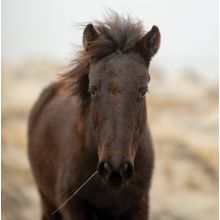
If you head past Corolla and keep driving north, you’ll notice that things start to change. The pavement ends, houses become scarce and the beach grows quieter. Out here, among the sand and brush, you’ll come across one of the Outer Banks’ most memorable sights: wild hors es, living off the land just as they have for generations.
A land-race breed known as Banker horses, they are descendants of Colonial Spanish mustangs and have evolved over centuries in this particular coastal environment. The Banker horses trace their roots back to Spanish mustangs that arrived here centuries ago. Legend says that their ancestors survived a shipwreck in the 1500s and swam to shore. No one knows for sure if that’s true, but the tale still stands. Today, the herd of more than 130 horses is a large part of what makes the Northern Outer Banks so remarkable. In 2010 North Carolina even named them the official state horse, a nod to their history and uniqueness to the area.
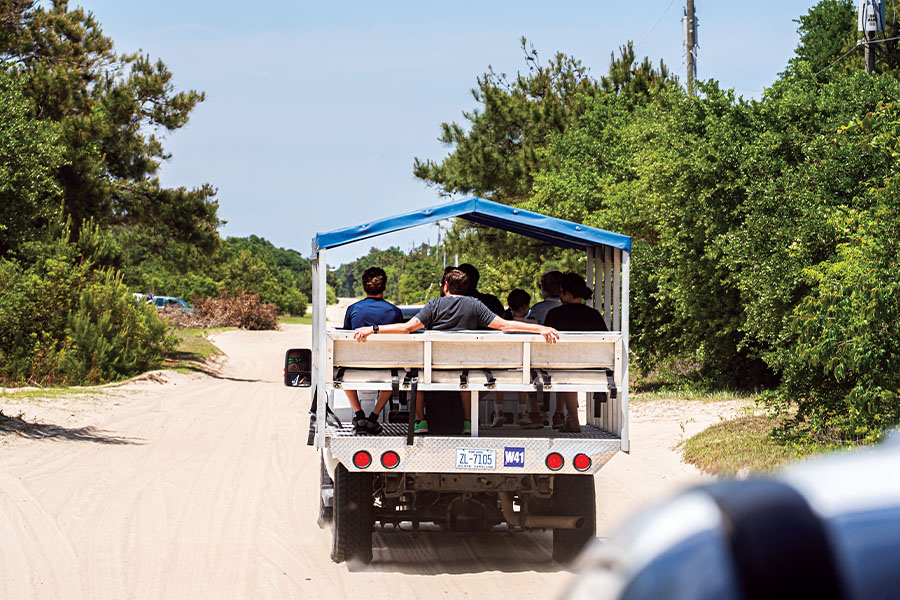
Seeing the wild Banker horses on your own can be tricky. They are only found in the 4WD area north of Corolla, and this definitely is not the place to learn how to drive on sand. The best way to see them is with a guide, and that’s why Corolla Wild Horse Tours exists. They’ve been around safely guiding since 1996, in open-air safari-style trucks that can handle the terrain with ease and driven by guides who know how to find the horses. Each truck holds about 15 people, and the setup makes it easy to take in the scenery along the way.
Many people are surprised by how regular the horses’ lives are, even though they’re wild. They don’t just roam the coast at random. Banker horses live in small groups called harems, usually with a dominant stallion and a few mares. Though they move around a lot in the day, the harems stay close to one another.
Not all horses belong to a harem. Stallions without a group form bachelor bands, and sometimes they challenge others to take over a harem. These fights can get rough, but they help keep the herd balanced.
A typical Corolla Wild Horse tour runs about two hours, and for the guides the experience of exploring and learning together is as important as spotting the horses. You’ll want to bring water and sunscreen, especially in the warmer months. Beyond that, just be ready to settle in and enjoy the ride. The mix of people on board is part of the fun. You might be sitting next to someone from a nearby town or someone visiting from the other side of the world, all of you bouncing along the same stretch of beach.
This year, Corolla Wild Horse Tours has freshened up its fleet with customer comfort in mind. They offer Ford F350s outfitted with forward facing bench seats, great for larger groups.
Guides usually give updates on the herd’s health and habits during the tour, along with tidbits of history and answers to any questions that come up. If you’re lucky, you might catch the horses near the water.
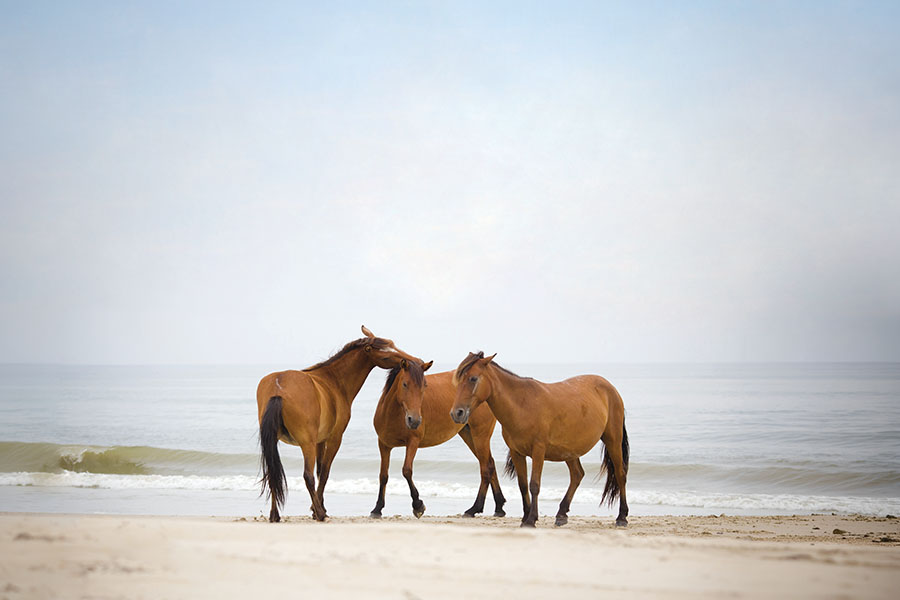
On hot days, they sometimes stand in the surf break to cool off and get away from biting flies. It makes for a pretty incredible scene, but it’s also a nice reminder that this is their natural environment, not just a photo op.
There’s also a bigger story behind the scenes. The nonprofit Corolla Wild Horse Fund works to protect the herd and keep it living in the wild. Bob White, owner of Corolla Wild Horse Tours, is the board chair of the fund.
“We are working hard to conserve open space for the horses,” White says. “They need space for grazing, their safety, and to secure their future.”
Something the fund, local government, tour companies and locals take very seriously is not interfering with the herd and leaving them to their own devices. There are laws in place to protect the horses, including keeping at least 50 feet away from them at all times, even if they approach you first. Feeding them isn’t allowed either, even if it seems harmless. Human food (yes, even apples and carrots) are dangerous, even fatal, for the horses. Giving them space is part of respecting them and their place in the wild.
There aren’t many places left where you can watch horses living wild like this, and Corolla Wild Horses Tours is a great way to see the horses for yourself and spend a few hours experiencing a small part of a bigger, older Outer Banks story.
(252) 207-0511 | 1159 AUSTIN STREET F, COROLLA
BOOK YOUR TOUR TODAY: SEECOROLLAWILDHORSES.COM
About the Author Leah Wingenroth
 Leah was born and raised on the Outer Banks and is an alumnus of Appalachian State University and King's College. She currently resides in England, writing and managing content in the lifestyle, education, travel and literary publishing sectors.