
Living on a barrier island means the shoreline is always changing. Storms, tides, waves, currents and sea level rise reshape the beaches. While that dynamic nature is part of what makes the Outer Banks so unique, it also creates challenges for oceanfront communities, roads, infrastructure and beaches.
And that’s where beach nourishment comes in. Love it or hate it, beach nourishment is currently an erosion management tool on the Outer Banks.
The process involves dredging sand from offshore borrow areas and pumping it onto eroded beaches to rebuild wider shorelines and protective dunes. Supporters view beach nourishment as an investment in protecting homes, businesses, roads and the tourism economy that sustains the Outer Banks. The wider beaches create a stronger buffer between the ocean and the homes, businesses, roads and public infrastructure that make life and vacations on the Outer Banks possible. (Full disclosure: As a Town of Nags Head Commissioner, I supported paying for the Nags Head beach nourishment project in 2026.)
But not everyone agrees that beach nourishment is the right answer. Critics argue that it is expensive, temporary and must be repeated every few years as storms and natural erosion continue to move sand away. Many question whether communities can afford these projects indefinitely. Surfers and fishermen do not appreciate the way beach nourishment shifts the sandbars. People also raise concerns about impacts on marine ecosystems and wildlife (sea turtle monitoring is conducted throughout construction to minimize impacts to nesting wildlife). Those opposed to beach nourishment point to other coastal management options, such as retreat, which requires moving homes and infrastructure away from the ocean instead of adding sand.
As with many coastal management issues, there are no easy answers, but for now beach nourishment is a regular part of coastal management throughout Dare County. Under normal conditions, nourishment projects are designed to last anywhere from five to eight years before maintenance nourishment is needed to restore sand lost to storms and natural erosion.
This summer, three major beach nourishment projects are taking place in Avon, Buxton and Nags Head. Here are a few details about the projects, and much more information can be found here.
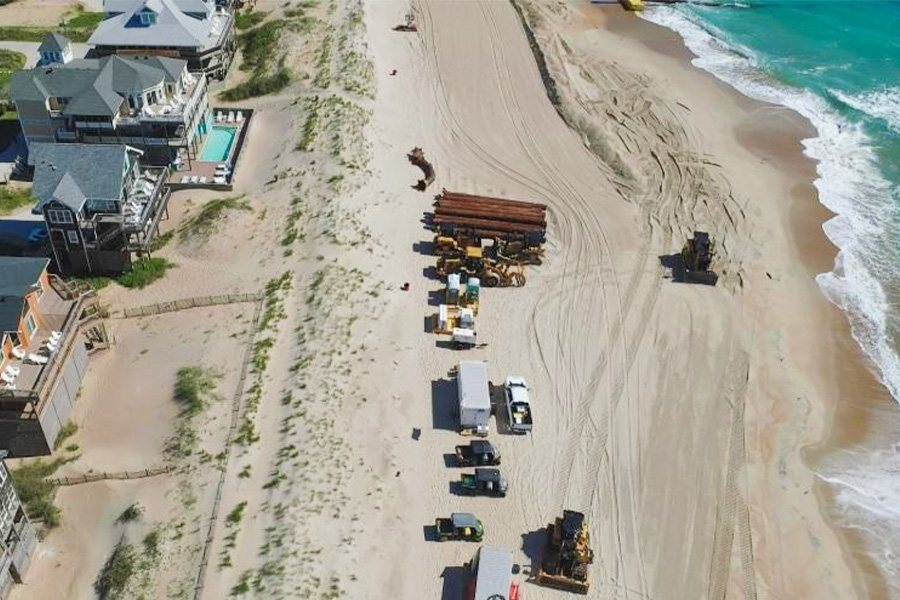
This photo and above: Beach nourishment activity in Avon in May 2026. Photos courtesy of Dare County
Avon
The 2026 Avon Beach Nourishment Project began in late May and was expected to take two weeks. The $7.7 million project focuses on approximately 2.5 miles of shoreline between Avon Pier and the National Park Service boundary to the south. While the wider beach will certainly be appreciated by residents and visitors, Dare County says its primary goal is protecting N.C. Highway 12 from chronic erosion hotspots.
Dare County's contractor, Great Lakes Dredge and Dock Company, is placing approximately 375,000 cubic yards of sand along Avon's oceanfront. Work began near Seaside Street and is progressing north toward Avon Pier before moving south to complete the project.
Visitors should be aware that Cape Hatteras National Seashore's parking lot at Off-Road Vehicle Ramp 38 remains closed through July 15 while the project is underway. Beachgoers may also encounter occasional delays as equipment moves on and off the beach.
View the Avon Beach Nourishment Progress Map.
Buxton
Perhaps the most closely watched project this year is taking place in Buxton. The village has been in the national spotlight due to a series of oceanfront home collapses, severe erosion and the failure of the terminal groin near the NPS Buxton Beach Access. Most recently, an unoccupied house collapsed into the ocean on June 2, scattering debris along the shoreline and prompting temporary beach closures from the north end of Buxton through the lifeguarded beach area. The collapse marked the fifth home lost this year and the 21st since September 2025.
In response to ongoing erosion concerns, Dare County expanded its Buxton Beach Nourishment Project from its original plan. Dare County commissioners approved increasing the project from approximately 1.35 million cubic yards of sand to 2 million cubic yards, bringing total project costs to roughly $42.2 million. They say the purpose of the project is primarily to protect infrastructure, with the added benefit of protecting homes and properties.
The project will cover approximately 2.9 miles of shoreline from Haulover Day Use Area to the terminal groin (the southernmost of three groins near Buxton Beach Access). Construction is expected to begin in mid-June and continue for much of the summer (approximately 95 days), potentially into September depending on weather and funding.
A Buxton terminal groin repair project is part of the broader 2026 beach nourishment project in Buxton. The terminal groin was originally constructed to help stabilize the shoreline and reduce erosion by trapping sand and protecting N.C. Highway 12. Over time, portions of the groin have become buried or damaged due to shifting sands and storm impacts. Since the groin is more than 50 percent damaged, it can be repaired as part of the upcoming nourishment project.
View the Buxton Beach Nourishment Progress Map
Keep up with National Park Service/Cape Hatteras National Seashore Beach Access and Closures
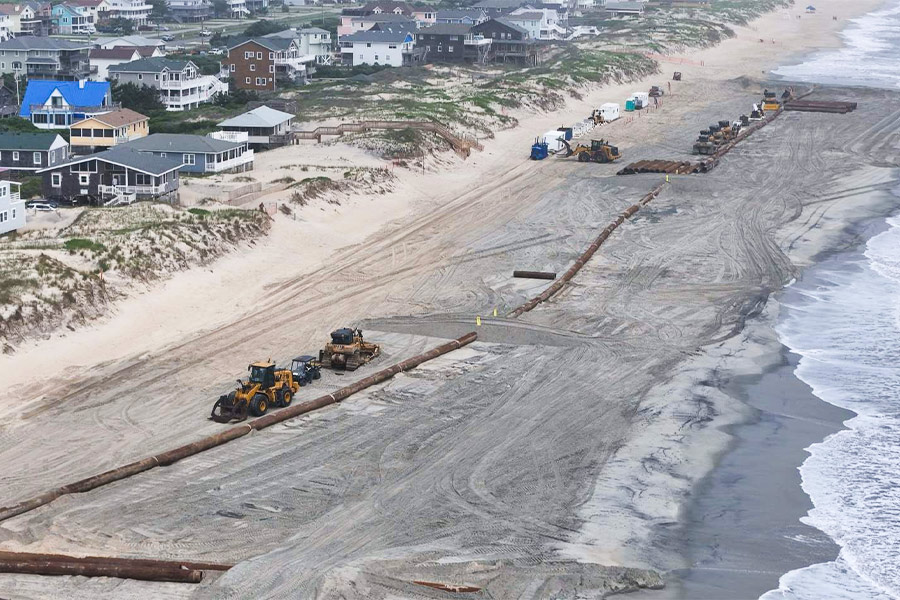
Photo: Beach nourishment activity in Nags Head in May 2026. Photo courtesy of Town of Nags Head Facebook
Nags Head
Beach nourishment is also underway in Nags Head, where crews are working from Bonnett Street south to the Cape Hatteras National Seashore boundary. The $36,461,600 project is designed to protect shorelines, dunes and infrastructure while maintaining the wide beaches that serve as both storm buffers and economic drivers for the community. The Juncos Street and Conch Street beach accesses will be closed for portions of the project.
Nags Head beach nourishment construction began on May 19, with initial equipment staged in South Nags Head near Camelot Street, around the 9700 block of South Old Oregon Inlet Road in South Nags Head. Two dredges are at work. A cutter-head dredge is at the southernmost landing point near Camelot Street in the 9700 block of South Old Oregon Inlet Road. This dredge will remain stationed offshore, continuously pumping sand to the beach. Though the dredge suffered a weather delay this week due to high winds, it is back in action.
A hopper dredge is working in the northern area of Nags Head. This dredge began work at the northernmost landing point just south of Nags Head Pier in the vicinity of the 3400 block of South Virginia Dare Trail. They have completed from Nags Head Pier to Bonnett Street (the northern terminus). Now they are working south toward Hollowell Street.
Town officials expect the project to be completed during the first half of July, weather permitting.
Check the Town of Nags Head construction progress map for updates.
Check the Town of Nags Head beach nourishment updates.
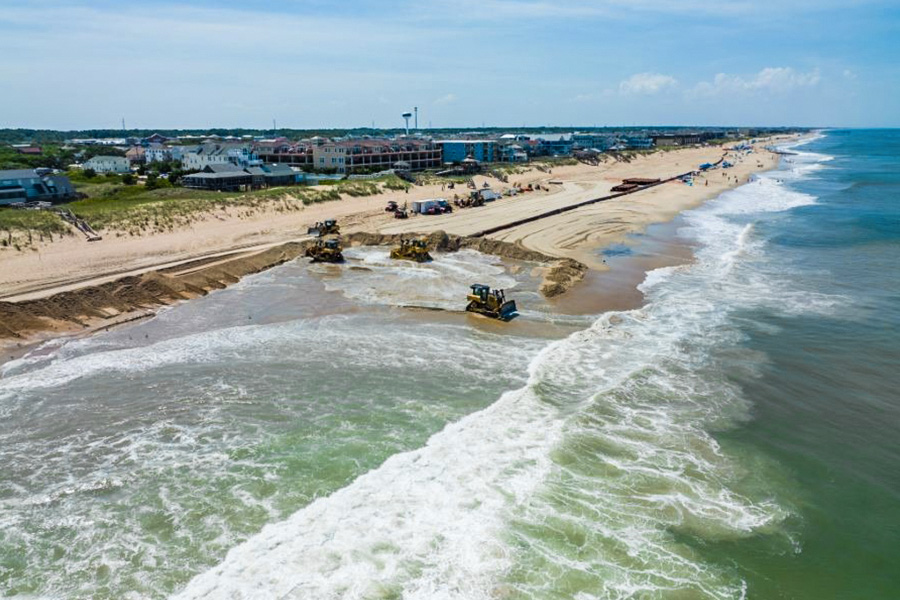
Photo: Beach nourishment in Kill Devil Hills in 2022. Photo courtesy of Dare County
The beach nourishment projects do cause some temporary inconveniences for beachgoers, such as beach access and beach closures in some areas, along with pipes and heavy equipment on the beach and the noise of bulldozers and excavators. In many areas the contractors can provide sand ramps over pipelines or walking areas behind the equipment and keep the beach open. When work is occurring on a stretch of beach, the crew is usually done and moving on within three to six days. Beach nourishment is temporarily disruptive to the beach, but it is very interesting to watch the processes and work.
Many people ask why beach nourishment takes place in the summer when the most visitors are here, and it's because wind and wave conditions are typically more favorable in the summer months.
The Beach Nourishment work in Dare County won't stop with Avon, Buxton and Nags Head in 2026. Maintenance nourishment projects are already planned for 2027 in Duck, Southern Shores, Kitty Hawk and Kill Devil Hills.
About the Author Molly Harrison
 Molly Harrison is managing editor at OneBoat, publisher of OuterBanksThisWeek.com. She moved to Nags Head in 1994 and since then has made her living writing articles and creating publications about the people, places and culture of the Outer Banks.