
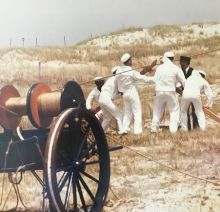
Before Coast Guard helicopters and ships could race offshore to respond to boats in distress, saving shipwrecked sailors on the Outer Banks came down to a handful of men at a remote Life-Saving Station, a small cannon, hundreds of yards of rope and an unfathomable amount of courage.
Visitors can see how they did it every summer Thursday afternoon at Chicamacomico Life-Saving Station Historic Site and Museum in Rodanthe. Volunteers recreate the Beach Apparatus Drill once practiced weekly by members of the U.S. Life-Saving Service. The demonstration offers a glimpse into Outer Banks’ maritime history and the men and practices that shaped the U.S. Coast Guard.
Photo above: See the Beach Apparatus Drill Reenactment on Thursdays in the summer season at Chicamacomico Life-Saving Station Historic Site and Museum in Rodanthe. The last one for this summer season will be September 10. Photo courtesy Chicamacomico.org.
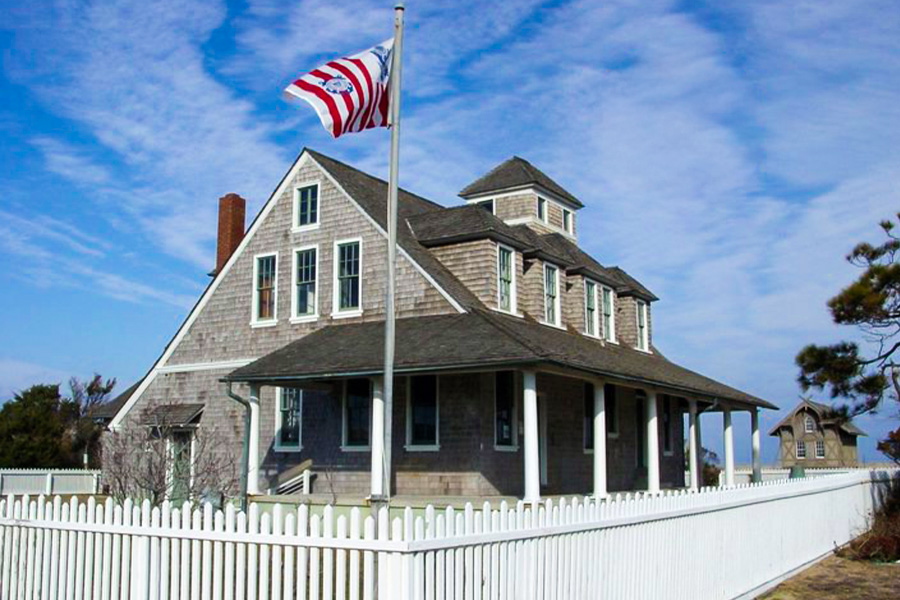
Photo: Chicamacomico Life-Saving Station Historic Site and Museum is one of the few U.S. Life-Saving Service sites in the nation with all its original buildings. Photo courtesy CHLSS.
An Important Piece of Life-Saving History
Chicamacomico was the first of seven Life-Saving Stations built in North Carolina in 1874 and the first to be staffed in the state. Its original station building was commissioned on December 4, 1874.
Today, Chicamacomico is a restored maritime historic site, one of the few telling the complete story of a U.S. Life-Saving Station. The property includes two original Life-Saving Service/Coast Guard station buildings – the original 1874 station and the 1911 station that replaced it – as well as cookhouses, a stable, water towers, a potable-water beehive cistern and an extensive collection of period rescue equipment.
The site also tells the stories of the men who performed some of the most remarkable rescues in American maritime history. In 1918, late in World War I, the British tanker Mirlo was struck by a torpedo from German U-boat 117 off the Outer Banks. Chicamacomico Keeper John Allen Midgett and his crew launched a surfboat into a fiery Atlantic and saved 42 sailors. The U.S. Coast Guard recognizes the Mirlo rescue as one of the top rescues in the maritime service’s history.
Visitors can see the actual self-bailing motor surfboat No. 1046 used in the rescue, along with photographs, interviews and other artifacts.
Another legendary lifesaver with ties to Chicamacomico was Rasmus Midgett, who trained at the station from 1888 to 1890. While serving at Gull Shoal Station in August 1899, Midgett was patrolling the beach on horseback when he encountered the wreck of the barkentine Priscilla. Working alone, he rescued 10 people. The Coast Guard recognizes his feat as one of the top 10 rescues in its history.
Those are two famous examples, but dozens of courageous rescues took place at Chicamacomico between 1874 and 1954.
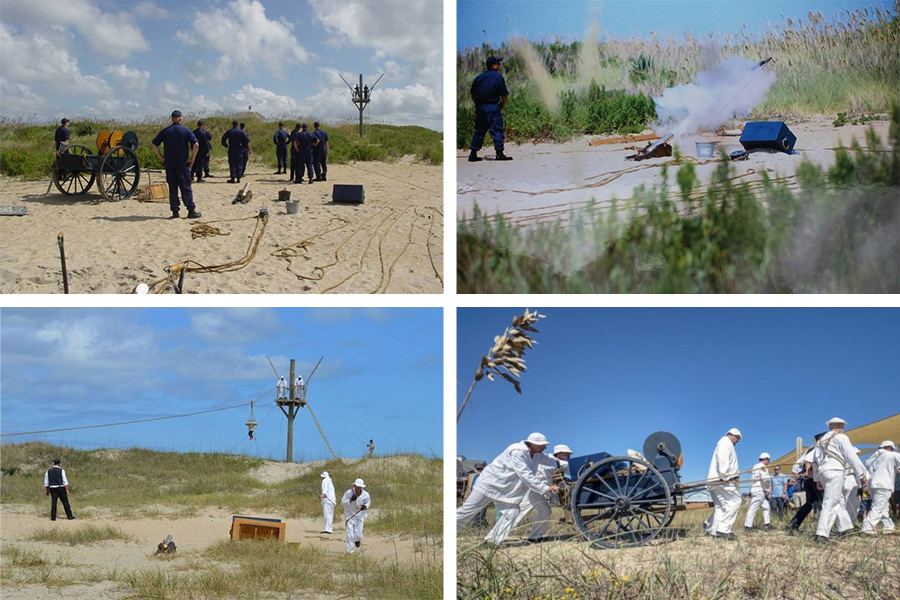
Photo: Images taken during Beach Apparatus Drill reenactments. Photo courtesy Chicamacomico.org.
Practicing for the Worst
When surfmen weren't responding to shipwrecks, they were preparing for them. The Beach Apparatus Drill, also known as the Breeches Buoy Drill, was a land-based rescue system. When rough seas made launching a surfboat too dangerous, lifesavers could establish a line between shore and a stranded vessel. A breeches buoy, essentially a life ring fitted with canvas breeches, traveled along the line, carrying one person at a time from the ship to safety.
The Beach Apparatus was the collection of equipment needed to carry out the rescue, while the Beach Apparatus Drill was the practice that ensured every crew member knew what to do. The practice and drill were part of regular operations until U.S. Coast Guard helicopter rescues became available in the 1950s.
More than a century later, that's still when you'll find the crew drilling at Chicamacomico in the summer months.
The modern demonstration is performed by volunteers, including Larry Grubbs, president of Chicamacomico Historical Association's Board of Directors, who portrays the station keeper in the weekly drills.
I talked with Grubbs about what visitors see on Thursdays, the volunteers who keep the tradition alive and why the history of the U.S. Life-Saving Service still matters.
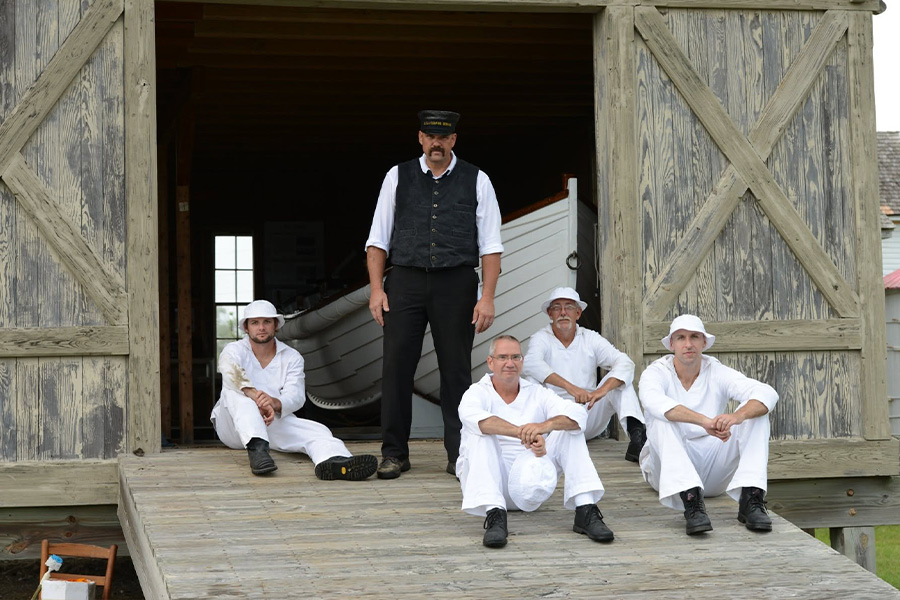
Photo: Beach Apparatus Drill reenactment volunteers, with Larry Grubbs portraying the keeper. Photo courtesy of Chicamacomico Facebook.
Q&A with Larry Grubbs, Station Keeper in the Beach Apparatus Drill
How did you get involved with the Beach Apparatus Drill?
I have been involved with Chicamacomico since the early 1990s. The National Park Service performed the drill in the early 1980s and early 1990s, and when they looked for volunteers to pick it up, I started in the early 1990s.
What made you want to get involved?
I grew up in Manns Harbor and have lived in Rodanthe since 1989. My mom was a Midgett, a descendant of the Midgetts who served at Chicamacomico. When I was asked to reassemble the volunteers and get the drill going again, I was able to find local guys to help. Since then, it's been all local guys. One of the unique things about our drill team is that at least four of our volunteers have blood ties to Chicamacomico. We have about 10 volunteers, eight regulars and a couple of alternates.
Is it difficult to find volunteers to help out at the Chicamacomico drills?
At first, it was hard to get volunteers in the summer. But once we got it up and running and proved ourselves, it became easier. Once they sign up and interact with the public, it's easy to keep them.
What makes the demonstration at Chicamacomico different from what visitors can see at other historic lifesaving stations?
It's one of very few places in the United States where you can learn about Life-Saving Service history this way. The only other place I'm aware of doing the drill weekly is a station on Cape Cod. It's extremely rare to see this bit of history.
How many people come out to watch the drill each week?
We usually have around 75 to 100 people each week. A hundred is a lot these days. We used to have a lot more in the 1990s.
What goes into putting on one of these drills today?
There is 20 hours of training involved before a volunteer is permitted to perform for the public. We train every spring. One thing to understand is that the drill isn't a reenactment of a rescue. It's a reenactment of the training they did.
What do visitors get to do besides watch?
The experience is of eight guys doing very different things with a common goal, so people notice different things. The visitors ask different questions after the drill every week. We let them participate in some hands-on activities, like putting the line back in the correct pattern in the faking box, helping clean the gun and put the equipment back. We let them be hands-on with the equipment.
What do you hope visitors understand about the men of the U.S. Life-Saving Service after watching the drill?
For the most part, people don't know much or anything about the U.S. Life-Saving Service, but when they leave here they do. Also, the stations helped shape the geography of the Outer Banks. The stations were built every seven miles, and the towns and villages of the Outer Banks sprung up around them. There was steady employment at the stations so the surfmen built houses close by. Then came churches, schools and stores and the villages.
And the bravery that these guys had and their sense of duty is beyond anything I've seen. I'm a 30-year retired paramedic and firefighter and ocean rescuer. I always had a team of guys helping right outside the danger area. These guys didn't have that backup. They just made do with what they had. You know, the Life-Saving Service is known as America's forgotten heroes.
What should people know before coming to see the drill?
Back in the day, the drill was a long walk. Nowadays, it's about a 50-yard walk and mostly in grass. People with mobility issues can get to the viewing area, although there is still a portion of the area that’s in sand. There's a much better opportunity to see the drill now than there was before. We have shade and bench seats. The viewer experience has gotten a lot better.
Also, your admission price is for a week, so if you want to look around at all the exhibits with no crowds, come on a day before or after the drill. The day of the drill is busy. There are a lot of artifacts for people to see. Drill day isn't the day to try to see everything unless you get there early.
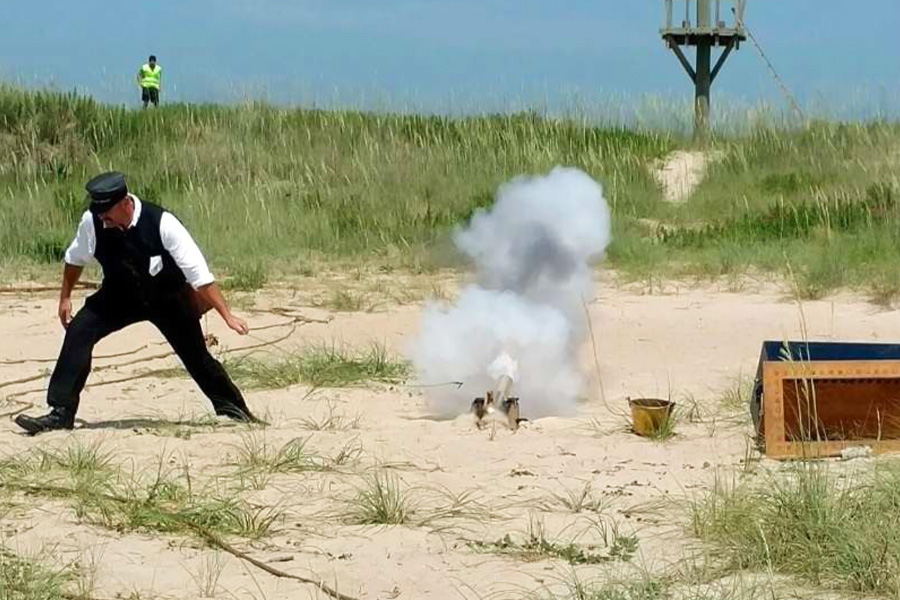
Photo: Firing the Lyle Gun during a Beach Apparatus Drill. Photo courtesy Chicamacomico.org.
See the Beach Apparatus Drill
- When: Thursdays at 2 p.m. through September 10. Get to the drill early, by 1:30 for history and shipwreck stories.
- Where: Chicamacomico Life-Saving Station and Historic Site, 23645 N.C. Highway 12, Rodanthe, NC
- Hours: Monday through Friday from 10 a.m. to 5 p.m. (Closed on Memorial Day, Independence Day and Labor Day)
- Admission: General admission is $10; family admission for up to five family members is $30; seniors ages 65 and older and students costs $9; youth ages 4 to 14 costs $6; and children younger than 4 are admitted for free. Admission includes the program and is good for the entire week.
- Information: (252) 987-1552; Chicamacomico.org, Facebook
About the Author Molly Harrison
 Molly Harrison is managing editor at OneBoat, publisher of OuterBanksThisWeek.com. She moved to Nags Head in 1994 and since then has made her living writing articles and creating publications about the people, places and culture of the Outer Banks.