
The lights dim. A storm rolls in. Waves crash across the stage as actors packed into a boat brace against the wind, not just suggesting a journey across the Atlantic Ocean, but taking you there.
This isn’t quite The Lost Colony you remember.
Over the past couple of years, The Lost Colony has undergone a significant transformation – a more than $4 million one, in fact. Backed by a $5 million directed grant from the State of North Carolina, the long-running outdoor drama – now in its 89th season! – has been reimagining nearly every aspect of the experience, from what you see and hear to what’s happening behind the scenes.
According to Chuck Still, executive director of Roanoke Island Historical Association, which produces the show, the changes have been both creative and practical.
In 2021 the production debuted a reworked version of the show with new creative and conceptual direction. By 2022 the team began modernizing the technology, at first by renting equipment to test what worked.
“Since 2022 the show has had a full musical score,” Still says. “It's had projections instead of scenery. It's had the puppets. It's had all that stuff. All that was an attempt to make the show move quicker and be more appealing to a modern audience.”
In 2024 they purchased that equipment to make those changes permanent.
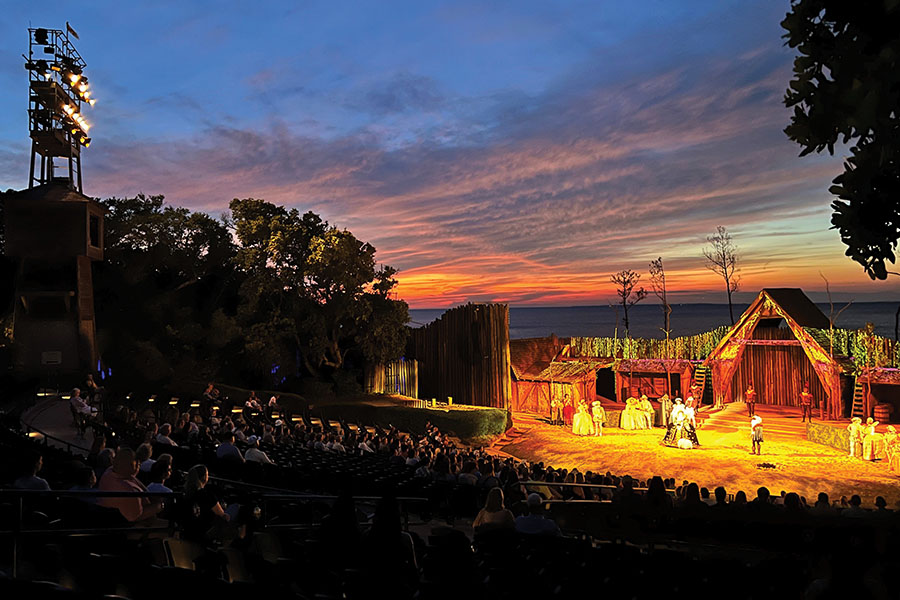
With new projectors, upgraded lighting and a fully modern sound system, including speakers, soundboard, amplifiers, wireless microphones and radio frequency scanning, the show now moves with a pace and polish that feels much more contemporary. Scenes shift seamlessly, and the story unfolds in a way that keeps today’s audiences, especially families, fully engaged for the whole show.
One of the biggest visual upgrades comes from replacing traditional set changes with projections.
“The projections also allow us to do some things that we couldn't do with scenery,” Still says.
Nowhere is that more evident than in the dramatic ocean crossing at the end of Act I. What was once implied, with actors appearing to board a ship and sails traveling behind the set, is more fully realized with projections of breaking waves and rain, intense storm sounds and such rollicking motion that the point fully clicks: The journey across the Atlantic was harrowing.
Not surprisingly, some longtime fans have noticed the shift in style.
Still admits that some people feel the updates have made the show more “Disneyfied,” a comparison that can raise eyebrows for some and highly appeal to others.
“I think that's right. I mean, I think it has gotten to be more like a Disney production,” he says. “But if you're trying to sell tickets to families on vacation at the beach, being more Disney probably is more appealing to families on vacation.”
That balance, honoring tradition while keeping the show relevant, is at the heart of the transformation.
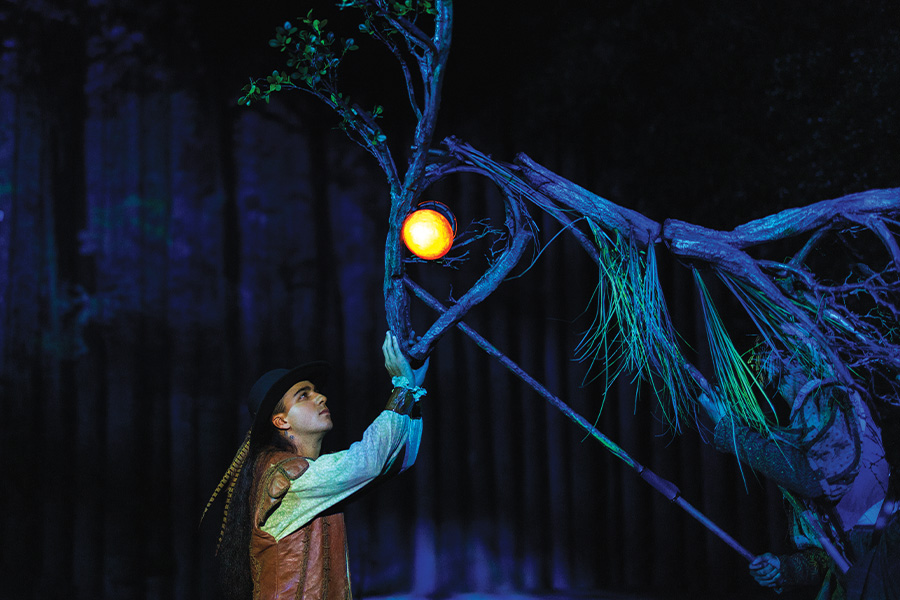
For the elements that cannot be projected, the team found creative solutions. Take the trees behind the palisade wall. For years, real pines were cut from nearby Morrison Grove, hauled in and set up backstage to create depth. They looked great at first, but within weeks, they dried out, dropped needles and lost their realism.
The production brought in puppet designer Nick Mahon to create seven large artificial trees, investing about $80,000 in a solution that looks just as good on closing night as it does on opening night.
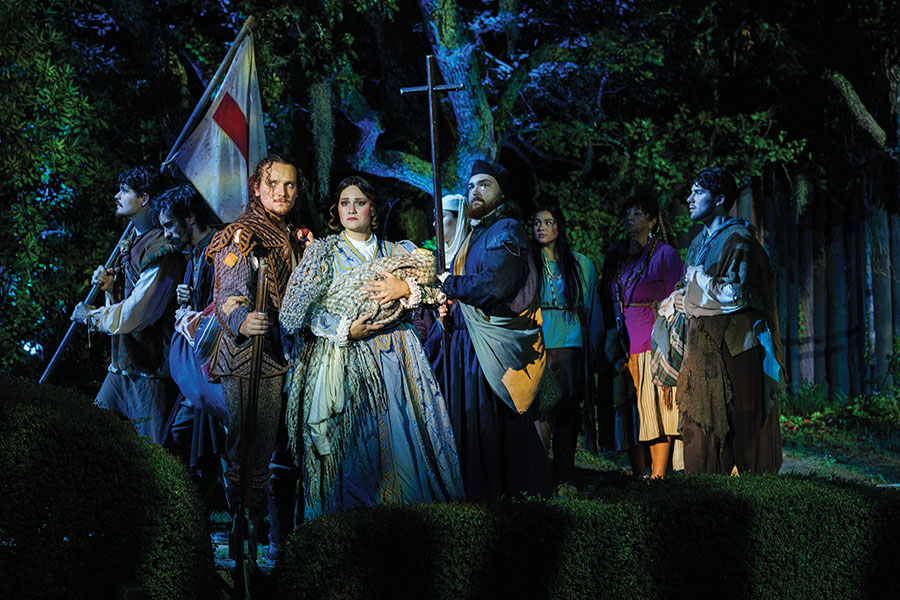
Costumes, another essential layer of the storytelling, got attention too. Behind the scenes, the costume shop was outfitted with new washers and dryers, industrial sewing machines and a leather sewing machine for Native American garments.
“We spent money on labor and fabric to rebuild some of the costumes, because some of them were dying out,” Still says.
Beyond what audiences can see, significant work has gone into preserving the physical structure of historic Waterside Theatre. That includes new roofs on multiple buildings, a complete rebuild of backstage decking, waterproofing and upgrading the electrical systems, and structural reinforcements to ensure long-term stability.
And then there’s the shoreline itself. A major protection project, costing between $900,000 and $1 million, added riprap along the soundside from the back of the costume shop to The Elizabethan Gardens. It’s a critical investment in slowing erosion and protecting the land the theater depends on.
“The most lasting thing may actually be the shoreline protection, because at The Elizabethan Gardens in particular, the erosion there is so incredible that to finally get rock there, to slow that down, is really a great thing,” Still says.
The final piece of the puzzle focuses on something audiences may never see but that absolutely affects the show: the cast and crew housing.
At Morrison Grove, where performers live during the season, housing has been fully renovated with updated kitchens, floors, bathrooms and living spaces. The goal was to create a better environment for the people who bring the story to life.
“Making that a nicer place to live means a happier cast, which means a better show, so we try to make that as nice as we can for them,” Still says.
And in the end, that’s what all of this comes back to.
A faster-moving show. Stronger visuals. Better sound. A more immersive experience from the first moment to the final bows.
Ticket Office: (252) 473-6000
Administration: (252) 473-2127
1409 National Park Drive, Manteo
thelostcolony.org
About the Author Maggie Miles
 Maggie Miles is originally from the Outer Banks. She moved to Palm Springs in 2023 to work as an on-call reporter for the New York Times. Her portfolio includes contributions to The Times, BBC, MSN and many other media outlets. During her career, she has focused on a wide range of topics, including workplace corruption, gun violence, social justice, the environment, arts, health and wellness, travel and in-depth profiles of notable people and businesses.